Work Smarter, Not Harder
Marketing managers wear many hats—strategist, analyst, content creator, team leader, and more. With endless meetings, campaign deadlines, and performance reports, time often feels like the scarcest resource. But what if you could claw back hours from your week without sacrificing impact?
Here are some practical, proven time-saving tips to help marketing managers streamline their workflow and stay ahead of the curve.
- Automate Repetitive Tasks
Automation is your best friend. From email campaigns to social media scheduling, tools like HubSpot, Mailchimp, and Buffer can handle the grunt work while you focus on strategy.
- Use CRM workflows to automate lead nurturing.
- Schedule social posts in batches using content calendars.
- Set up automated reports for weekly performance metrics.
- Centralize Your Marketing Stack
Juggling multiple platforms slows you down. Consolidate tools where possible to reduce switching costs and data silos.
- Opt for all-in-one platforms (e.g., Salesforce Marketing Cloud or Zoho).
- Use integrations to sync data across tools.
- Create dashboards that pull key metrics into one view.
- Create Templates where possible
Templates save time and ensure consistency.
- Build reusable templates for emails, landing pages, briefs, and reports.
- Create a swipe file of high-performing content for inspiration.
- Standardize campaign planning documents.
- Prioritize with the 80/20 Rule
Focus on the 20% of activities that drive 80% of results.
- Identify your highest-performing channels and double down.
- Cut or delegate low-impact tasks.
- Use project management tools like Asana or Trello to visualize priorities.
- Delegate and Empower Your Team
You don’t have to do it all.
- Assign ownership of recurring tasks to team members.
- Encourage cross-training to build a flexible team.
- Use clear briefs and SOPs to reduce back-and-forth.
- Block Time for Deep Work
Multitasking kills productivity. Protect your calendar.
- Schedule uninterrupted blocks for strategy and creative thinking.
- Use time-blocking techniques to batch similar tasks.
- Turn off notifications during focus hours.
- Review and Refine Weekly
A short weekly review can save hours of misalignment.
- Assess what worked, what didn’t, and what to improve.
- Reallocate resources based on performance.
- Keep your goals visible and measurable.
Final Thoughts
Time is the currency of impact. By automating, prioritizing, and empowering your team, you can shift from reactive to proactive—and lead with clarity and confidence. Marketing managers who master time management don’t just get more done—they get the right things done
A Guide to Sustainable Success
In today’s climate-conscious world, building a greener brand isn’t just a noble pursuit—it’s a strategic imperative. Consumers are increasingly choosing companies that align with their values, and sustainability is at the top of the list. Whether you’re launching a startup or reimagining an established business, here’s how to build a brand that’s both eco-friendly and future-proof.
- Define Your Green Mission
Start with clarity. What does sustainability mean for your brand?
- Are you reducing carbon emissions?
- Promoting circular economy principles?
- Supporting ethical sourcing?
Your mission should be authentic, specific, and actionable. Avoid vague buzzwords—consumers can spot greenwashing from a mile away.
- Audit Your Impact
Before you can improve, you need to understand where you stand.
- Conduct a sustainability audit of your supply chain, packaging, energy use, and waste.
- Identify hotspots where you can make the biggest difference.
- Use tools like carbon calculators or lifecycle assessments to quantify your footprint.
- Rethink Products and Packaging
Eco-conscious design is a powerful brand differentiator.
- Use biodegradable, recycled, or reusable materials.
- Minimize packaging and eliminate single-use plastics.
- Design products for longevity, repairability, and recyclability.
Bonus: Sustainable packaging often leads to cost savings and better customer loyalty.
- Green Your Operations
Sustainability should be embedded in how you operate.
- Switch to renewable energy sources.
- Offer remote work options to reduce commuting emissions.
- Partner with green logistics providers.
Even small changes—like going paperless or installing LED lighting—can add up.
- Communicate Transparently
Your green efforts deserve to be shared—but with honesty and humility.
- Publish sustainability reports or impact statements.
- Use certifications (like B Corp, Fair Trade, or FSC) to build trust.
- Share your journey, including challenges and setbacks.
Transparency builds credibility and invites your audience to grow with you.
- Engage Your Community
Sustainability is a shared effort.
- Collaborate with local environmental groups or nonprofits.
- Encourage customers to participate—through recycling programs, eco-challenges, or donations.
- Educate your audience with content that inspires action.
A greener brand isn’t just about what you sell—it’s about the movement you lead.
Final Thoughts
Building a greener brand is not a one-time project—it’s a mindset. It requires commitment, creativity, and courage. But the rewards are immense: loyal customers, resilient operations, and a legacy that matters.
So start small, think big, and remember—every green step you take is a step toward a better world
In the world of B2B marketing, every pound spent needs to justify its existence. Unlike B2C, where emotional appeal and impulse buying often drive results, B2B decisions are rational, long-term, and involve multiple stakeholders. That’s why calculating Return on Investment (ROI) from marketing spend isn’t just a nice-to-have—it’s essential.
What Is Marketing ROI?
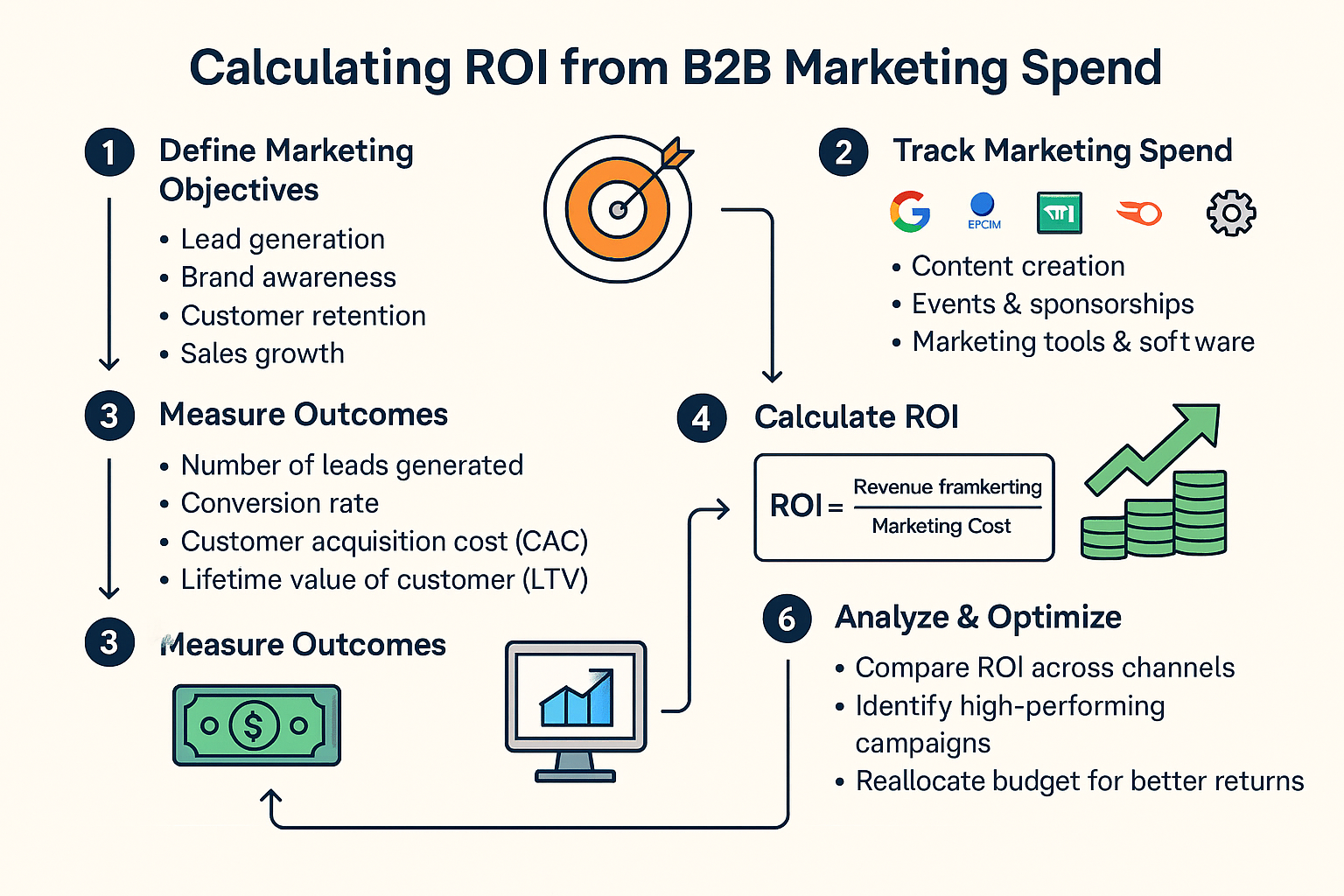
Marketing ROI measures the revenue generated from marketing activities relative to the cost of those activities. It helps businesses understand which campaigns are driving growth and which are draining resources.
Basic formula:
Marketing ROI=Revenue Attributed to Marketing−Marketing CostsMarketing Costs×100\text{Marketing ROI} = \frac{\text{Revenue Attributed to Marketing} – \text{Marketing Costs}}{\text{Marketing Costs}} \times 100
But in B2B, it’s rarely that simple.
Why B2B ROI Is More Complex
- Longer sales cycles: Deals can take months or even years to close.
- Multiple touchpoints: Prospects engage with various content and channels before converting.
- Attribution challenges: Which touchpoint gets credit for the sale?
To tackle this, B2B marketers need a more nuanced approach.
Step-by-Step Guide to Calculating B2B Marketing ROI
- Define Your Goals
Are you measuring ROI for lead generation, brand awareness, or customer retention? Each goal requires different metrics.
- Track Marketing Costs
Include:
- Ad spend
- Content creation
- Software/tools
- Agency fees
- Staff salaries (if applicable)
Be thorough—hidden costs can skew your ROI.
- Set Up Attribution Models
Choose how you’ll assign credit to marketing efforts:
- First-touch: Credit goes to the first interaction.
- Last-touch: Credit goes to the final interaction before conversion.
- Multi-touch: Distributes credit across all touchpoints.
Multi-touch attribution is ideal for B2B but requires robust analytics.
- Measure Revenue Impact
Use CRM and marketing automation tools to link leads and deals back to specific campaigns. Key metrics include:
- Number of qualified leads
- Conversion rate
- Average deal size
- Customer lifetime value (CLV)
- Calculate ROI
Apply the formula using the revenue attributed to marketing efforts. For example:
- Marketing spend: £50,000
- Revenue from marketing-generated leads: £200,000
ROI=£200,000−£50,000£50,000×100=300%\text{ROI} = \frac{£200,000 – £50,000}{£50,000} \times 100 = 300\%
Tools That Help
- HubSpot: CRM and marketing automation with ROI tracking
- Google Analytics: Tracks web traffic and conversions
- Salesforce: Links marketing campaigns to closed deals
- Tableau or Power BI: Visualise ROI across channels
Optimising for Better ROI
Once you’ve calculated ROI, use the insights to:
- Double down on high-performing channels
- Refine underperforming campaigns
- Align sales and marketing teams
- Improve lead nurturing workflows
Final Thoughts
ROI isn’t just a number—it’s a compass. In B2B marketing, where budgets are scrutinised and results take time, understanding ROI empowers marketers to make smarter decisions, prove value, and drive sustainable growth
Investing in SEO is like planting a tree. You water it, nurture it, and wait patiently for it to bear fruit. But how long should you wait before expecting results? If you’re wondering when your SEO efforts will start paying off, you’re not alone. Let’s break down the realistic time frame and what influences it.
The Short Answer: 4 to 12 Months
Most businesses begin to see measurable improvements in organic traffic and rankings within 4 to 6 months, but ROI—actual revenue impact—often takes 6 to 12 months. SEO is a long-term strategy, not a quick fix.
Factors That Influence SEO ROI Timeline
Here’s why the timeline varies so much:
- Website Age & Authority Older domains with established backlinks tend to rank faster than brand-new sites.
- Competition in Your Industry Highly competitive niches (like finance or health) require more time and effort to outrank established players.
- Content Quality & Quantity Publishing high-value, keyword-optimized content consistently accelerates results.
- Technical SEO Health A site with crawl errors, slow load times, or poor mobile usability will struggle to rank.
- Backlink Profile Earning quality backlinks from reputable sites boosts domain authority and speeds up ranking.
- Local vs. National SEO Local SEO (e.g., for a Wakefield bakery) often shows faster results than national campaigns.
What “Results” Actually Look Like
Before ROI hits your bottom line, you’ll likely see:
- Increased organic traffic
- Higher keyword rankings
- More impressions and clicks in Google Search Console
- Improved engagement metrics (time on site, lower bounce rate)
- More leads or conversions from organic sources
What You Can Do to Speed Things Up
- Audit your site for technical issues
- Target long-tail keywords with less competition
- Create content clusters around core topics
- Build strategic backlinks
- Track KPIs like traffic, rankings, and conversions monthly
Final Thoughts
SEO is a marathon, not a sprint. If you’re investing in SEO today, think of it as building a digital asset that compounds over time. The first few months are about laying the groundwork—after that, the growth curve can be exponential.
So, stay the course. The ROI is coming—it just doesn’t arrive overnight
How B2B Businesses Can Improve Their Social Media Engagement
In a world where attention is currency, social media isn’t just for B2C brands flaunting flashy products. B2B businesses have just as much to gain—if not more—from building meaningful engagement on platforms like LinkedIn, X (formerly Twitter), and even Instagram. But here’s the catch: B2B audiences crave value, not virality.
So how can your B2B brand cut through the noise and spark real conversations? Let’s dive in.
- Know Your Audience—Deeply
Before you post anything, ask: Who are we talking to?
- Define your buyer personas: job titles, industries, pain points.
- Understand their platform preferences—LinkedIn for thought leadership, X for quick updates, Instagram for behind-the-scenes.
- Tailor your tone and content to resonate with their goals and challenges.
- Share Expertise, Not Just Products
People don’t want to be sold to—they want to be smarter.
- Post thought leadership articles, whitepapers, and case studies.
- Break down complex industry trends into digestible insights.
- Use carousels, infographics, and short videos to make content more engaging.
- Start Conversations, Not Monologues
Engagement is a two-way street.
- Ask questions in your posts to spark dialogue.
- Respond to comments quickly and thoughtfully.
- Join relevant conversations in industry groups and hashtags.
- Use Data to Drive Content Strategy
Don’t guess—measure.
- Track which posts get the most likes, shares, and comments.
- Use analytics to identify optimal posting times and formats.
- A/B test headlines, visuals, and CTAs to refine your approach.
- Empower Your Team to Be Brand Ambassadors
Your employees are your secret weapon.
- Encourage them to share company content with their networks.
- Highlight team achievements and culture to humanize your brand.
- Offer training on personal branding and LinkedIn best practices.
- Go Behind the Scenes
People connect with people—not faceless corporations.
- Share office moments, team wins, and event highlights.
- Use Stories and Reels to showcase your company culture.
- Feature employee spotlights and customer testimonials.
- Be Consistent, Not Constant
Quality beats quantity every time.
- Create a content calendar to stay organized.
- Post regularly, but only when you have something valuable to say.
- Repurpose high-performing content across platforms.
Final Thoughts
Social media engagement for B2B isn’t about chasing likes—it’s about building trust, credibility, and relationships. When done right, it becomes a powerful engine for lead generation, brand awareness, and long-term growth.
Ready to level up your B2B social strategy? Let’s brainstorm your next big move
In a world where attention is currency, social media isn’t just for B2C brands flaunting flashy products. B2B businesses have just as much to gain—if not more—from building meaningful engagement on platforms like LinkedIn, X (formerly Twitter), and even Instagram. But here’s the catch: B2B audiences crave value, not virality.
So how can your B2B brand cut through the noise and spark real conversations? Let’s dive in.
- Know Your Audience—Deeply
Before you post anything, ask: Who are we talking to?
- Define your buyer personas: job titles, industries, pain points.
- Understand their platform preferences—LinkedIn for thought leadership, X for quick updates, Instagram for behind-the-scenes.
- Tailor your tone and content to resonate with their goals and challenges.
- Share Expertise, Not Just Products
People don’t want to be sold to—they want to be smarter.
- Post thought leadership articles, whitepapers, and case studies.
- Break down complex industry trends into digestible insights.
- Use carousels, infographics, and short videos to make content more engaging.
- Start Conversations, Not Monologues
Engagement is a two-way street.
- Ask questions in your posts to spark dialogue.
- Respond to comments quickly and thoughtfully.
- Join relevant conversations in industry groups and hashtags.
- Use Data to Drive Content Strategy
Don’t guess—measure.
- Track which posts get the most likes, shares, and comments.
- Use analytics to identify optimal posting times and formats.
- A/B test headlines, visuals, and CTAs to refine your approach.
- Empower Your Team to Be Brand Ambassadors
Your employees are your secret weapon.
- Encourage them to share company content with their networks.
- Highlight team achievements and culture to humanize your brand.
- Offer training on personal branding and LinkedIn best practices.
- Go Behind the Scenes
People connect with people—not faceless corporations.
- Share office moments, team wins, and event highlights.
- Use Stories and Reels to showcase your company culture.
- Feature employee spotlights and customer testimonials.
- Be Consistent, Not Constant
Quality beats quantity every time.
- Create a content calendar to stay organized.
- Post regularly, but only when you have something valuable to say.
- Repurpose high-performing content across platforms.
Final Thoughts
Social media engagement for B2B isn’t about chasing likes—it’s about building trust, credibility, and relationships. When done right, it becomes a powerful engine for lead generation, brand awareness, and long-term growth.
Ready to level up your B2B social strategy? Let’s brainstorm your next big move